Code Examples
Explore how Pāṇini handles real-world linguistic data across different languages and analysis modes.
🇹🇷 Turkish: Agglutinative Segmentation
Key Concept: Morpheme Inventory
Turkish is a highly agglutinative language where a single word can contain multiple grammatical functions. Pāṇini uses an Inventory to match surface forms to grammatical meanings.
# Example of Turkish segmentation
result = panini.extract(
    language="tur",
    text="gelmeyecekler",
    components=["morpheme_segmentation"]
)
Output Example:
* Word: gelmeyecekler
* gel (Verb Root)
* ma (Negative)
* y (Buffer)
* ecek (Future)
* ler (3rd Person Plural)
🇦🇪 Arabic: Morphological Aggregation
The Arabic example showcases Pāṇini's ability to perform statistical analysis over a corpora, specifically focusing on the 3-consonantal root system.
Pivoted Aggregation
In Semitic languages, verbs, nouns and adjectives can be constructed from a 3-consonantal root. For example, the root k-t-b (ك ت ب) related to "writing" generates: - kataba (كَتَبَ) — "he wrote" (verb) - kitāb (كِتَاب) — "book" (noun) - kātib (كَاتِب) — "writer" (noun) - maktaba (مَكْتَبَة) — "library" (noun)
Therefore, for those languages, it is often useful to aggregate data by root rather than by word. Panini's record_pivoted allows you to define a "pivot" callback to group results dynamically.
# Aggregate by root
aggregator.record_pivoted(
    lang_code="ara",
    result=extraction_result,
    pivot_callback=lambda feat: next(iter(feat.values())).get("root", "no-root")
)
📊 Visualizing Results
Pāṇini's aggregation data can be easily exported for visualization. Below are samples generated using the helper.py utility included in the examples.
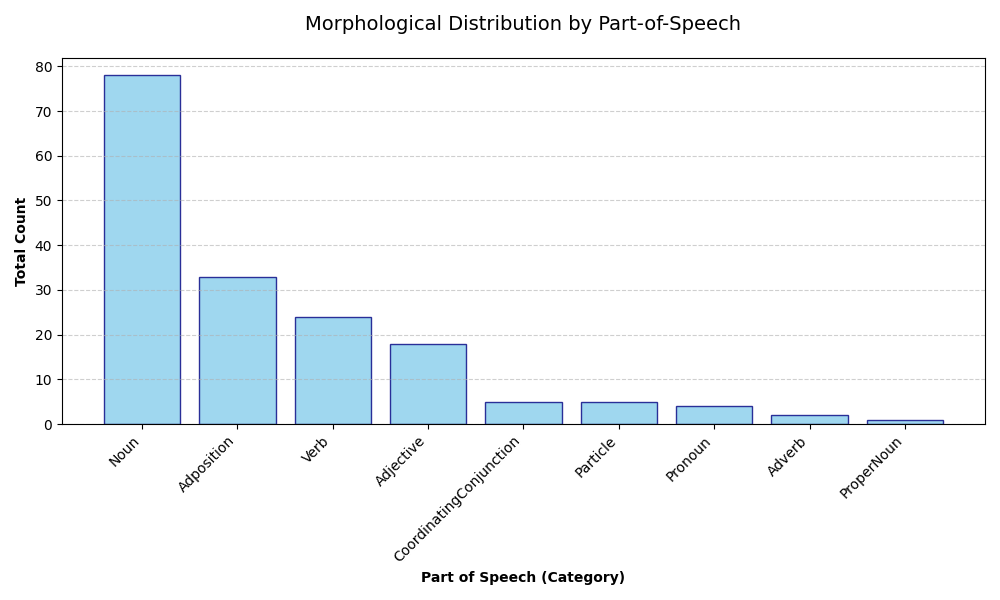
PoS Category Distribution
Understand the balance of nouns, verbs, and adjectives in your corpus.
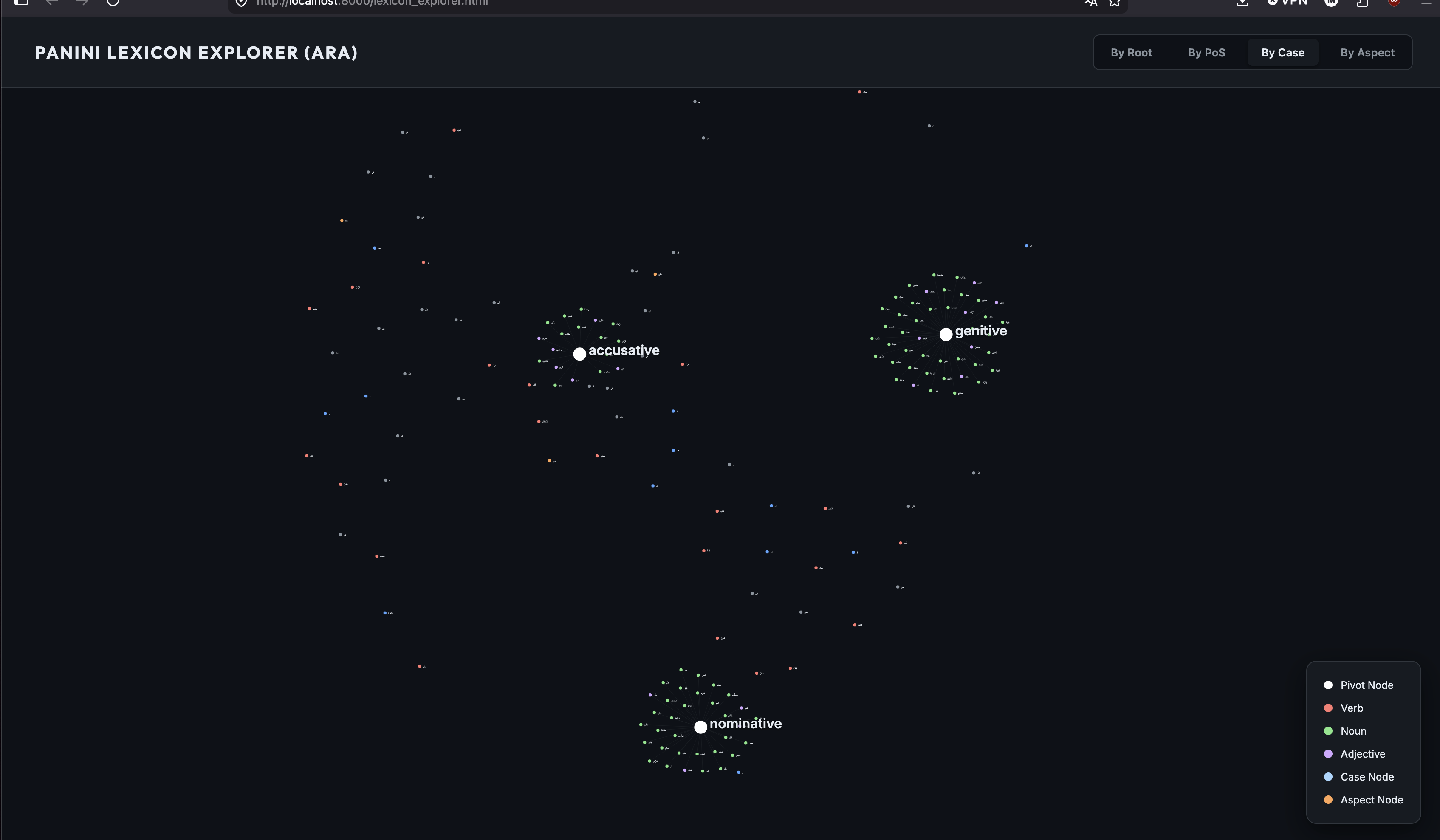
Case Distribution (Arabic)
Explore how case markers are used across the analyzed text.
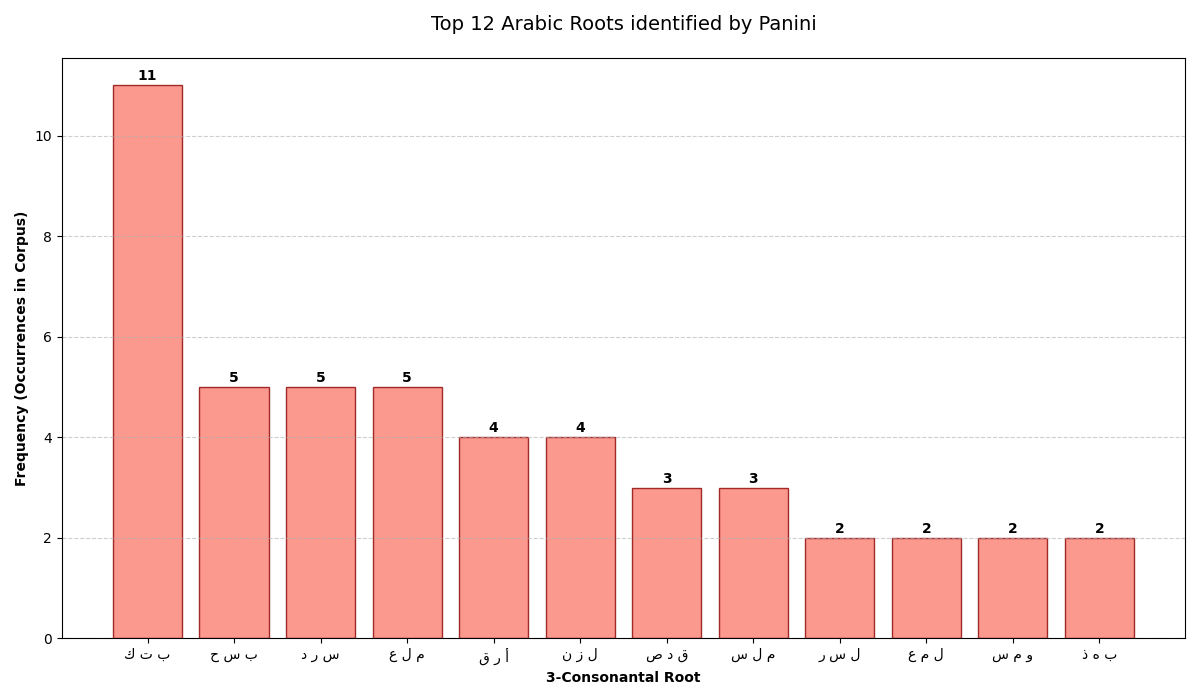
Root Frequency Analysis
Identify the most productive roots in your linguistic data.
🚀 Lexicon Explorer
For a truly immersive experience, the Python examples include a Lexicon Explorer dashboard built with D3.js.
- Interactive Network: View the relationships between roots and their lexical realizations.
- Dynamic Pivoting: Switch between views (Root, PoS, Case, Aspect) in real-time.
- Deep Insight: Hover over nodes to see the full morphological trait set.
[!TIP] Run the Arabic aggregation example in the
examples/pythondirectory to generate your ownlexicon_data.jsonand launch the dashboard!